NC · article
7 Signs Your AI Project Needs an Architect, Not Another Developer
You didn't hire a bad developer. You hired a good developer for an architect's job. Here's how to tell the difference.
part of Fractional AI CTO · 4 articles
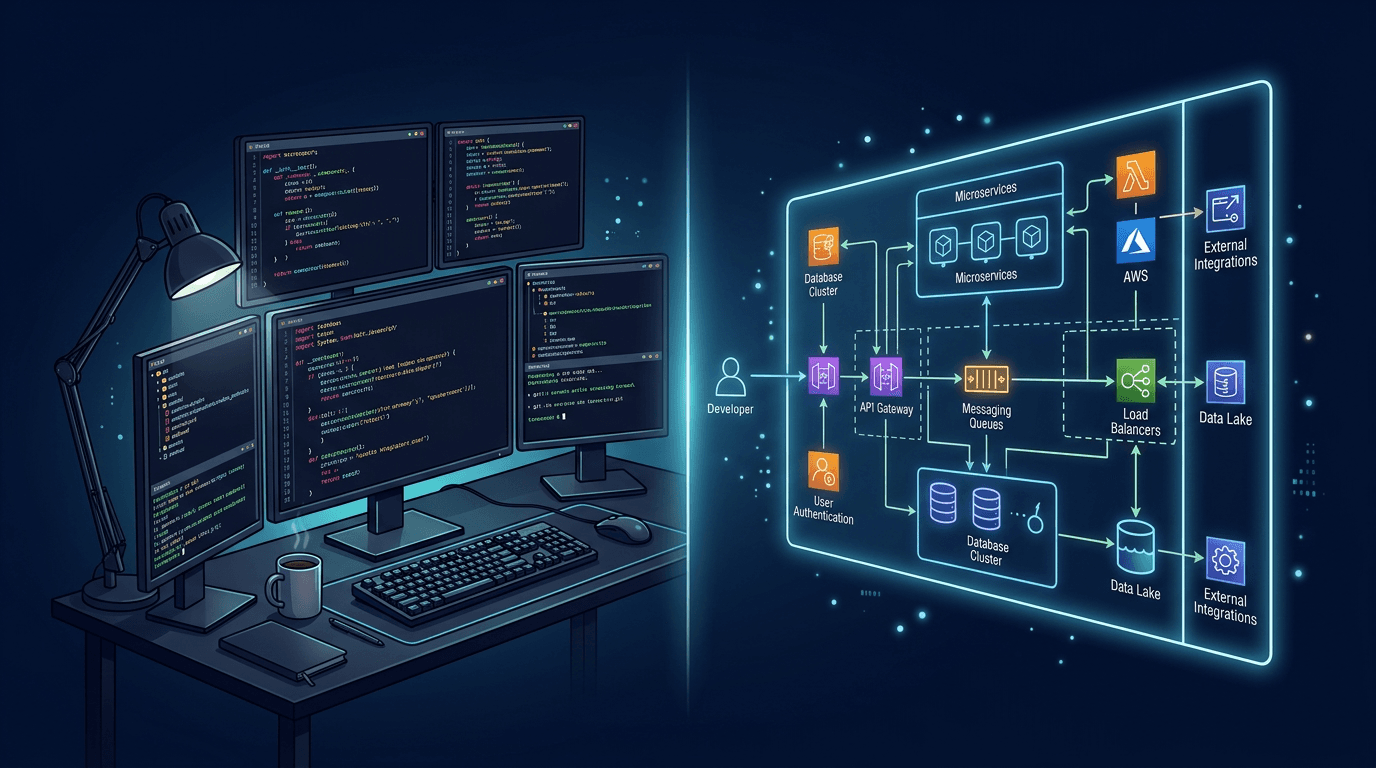
The developer you hired was probably good. Maybe even great. They knew Python, they knew LangChain, they could build a working demo in a week.
But the project failed anyway. Not because they lacked skill - because you needed a different type of expertise. You hired someone who could build features. You needed someone who could design systems.
This isn't a criticism of developers. It's a diagnosis. An orthopaedic surgeon and a physiotherapist are both medical professionals. But if you have a broken bone and you hire the physio, you're not going to get better - no matter how talented they are.
Here are seven signs that your AI project needs an architect, not another developer.
1. Your Prototype Works Perfectly But Can't Handle Real Data
The demo was impressive. It processed sample documents flawlessly. It answered questions accurately. Everyone was excited.
Then you fed it your actual data - messy PDFs, scanned images, inconsistent formatting, documents from three different systems in four different formats. Accuracy dropped from 90% to 55%. Processing time went from seconds to minutes.
What this means: The system was built for the demo, not for production. Demo data is clean. Production data is not. The gap between them isn't a bug to fix - it's an architecture problem. You need a data pipeline that handles preprocessing, normalisation, format detection, OCR for scanned content, and quality validation before anything reaches the AI model. That's system design, not code.
2. You Keep Adding Developers But Progress Slows Down
You started with one developer and things moved fast. You hired two more to speed things up. But instead of 3x progress, you got slower delivery, more bugs, and longer meetings about “who's building what.”
This is Brooks's Law applied to AI: adding people to a project without architecture creates coordination overhead that outweighs the additional capacity. Three developers without a shared architecture are building three different systems that don't fit together.
What this means: You need architecture before headcount. A clear component design, interface definitions, and integration contracts let developers work in parallel without stepping on each other. That document doesn't come from a developer - it comes from an architect.
3. Nobody Can Explain How the System Will Scale
Ask your team: “If we get 100x more users tomorrow, what breaks?” If the answer is a long pause followed by “we'd figure it out,” you don't have architecture.
Scaling isn't something you “figure out later.” It's determined by decisions made on day one - database choice, caching strategy, queue management, connection pooling, async vs sync processing. Retrofitting scale into a system that wasn't designed for it is 3-5x more expensive than building it in from the start.
What this means: If nobody on the team can draw the system on a whiteboard and point to every bottleneck, you have a code problem wearing architecture's clothes. (This is why I built SystemAudit.dev - paste a GitHub URL and get an architecture quality report, security audit, and test coverage analysis in under 3 minutes. It's a fast way to see whether a codebase has architecture or just code.)
4. Your AI Project Touches 3+ Systems and Nothing Integrates Cleanly
The AI model works in isolation. But connecting it to your CRM, document storage, email system, and database? That's where everything breaks. Timeouts, data format mismatches, authentication failures, missing error handling.
Integration is architecture work, not development work. It requires understanding the entire landscape - every system, every API, every data format, every failure mode - and designing a connection layer that handles all of it gracefully.
What this means: If your developers are spending 70% of their time on integration issues instead of AI features, the problem isn't development speed. It's the absence of integration architecture. In my experience, integration accounts for 40-60% of total project effort on enterprise AI systems.
5. You've Changed AI Frameworks or Providers More Than Twice
“We started with LangChain, then switched to LlamaIndex, then tried CrewAI, and now we're evaluating AutoGen.”
Tool-chasing is a symptom of missing architecture. When the system design is clear, the framework choice falls out naturally. When there's no system design, the team looks for a framework to be the architecture - and when each one doesn't solve the underlying design problem, they switch to the next one.
What this means: A clear architecture is framework-agnostic. The components, data flows, and integration patterns stay the same whether you implement them in LangGraph, CrewAI, or custom code. If changing the framework means redesigning the system, you didn't have architecture - you had a framework dependency.
6. Your Team Is Still Debating Whether to Use RAG, Agents, or Fine-Tuning
If this decision hasn't been made with a clear, documented rationale, you need an architect to make it.
This is the single most consequential AI pattern decision. Get it wrong and you spend months building the wrong thing. The choice depends on your specific data, use case, latency requirements, budget, and maintenance capacity - not on which framework the developer knows best.
What this means: Pattern selection requires someone who has built with all three approaches and knows the trade-offs from experience. A developer who has only built RAG systems will recommend RAG. That doesn't mean RAG is the right choice for your problem.
7. The Technical Lead Can't Explain Trade-Offs to the Business Team
The CFO asks “why is this taking so long?” The answer is a jargon-laden explanation about embedding dimensions and chunk overlap ratios. The CFO's eyes glaze over. Confidence drops. The next budget review becomes a fight.
Technical skill without stakeholder communication is a ticking bomb. AI projects live and die on executive confidence. If the person leading the project can't translate “we're implementing hybrid search with re-ranking” into “this will reduce document review time from 4 hours to 20 minutes,” the project will eventually lose its funding - even if the technology works.
What this means: You need someone who speaks both languages - the language of architecture and the language of business. That's the defining skill of an architect versus a developer.
What to Do About It
If you recognised three or more of these signs, the answer isn't hiring another developer. It's bringing in architecture expertise - even temporarily.
The fractional AI CTO model exists for exactly this situation. You hire an architect for 6-12 weeks to:
- Audit what exists and what's broken
- Design the architecture that should have been designed first
- Build a working pilot that proves the approach
- Document everything so your team can continue independently
Total cost: typically £12-40K for the engagement. Compare that to the cost of another six months of developers building on a broken foundation.
The reframe is simple: you didn't hire a bad developer. You hired a good developer for an architect's job. Now that you know the difference, you can make the right hire.
Not sure if your project has these problems? You don't need a technical background to find out. SystemAudit.dev analyses any GitHub codebase and produces a plain-English report covering architecture quality, security vulnerabilities, and test coverage - in under 3 minutes. If you're a CEO or COO wondering whether your AI project has a structural problem, this is the fastest way to get an objective answer before your next consultant conversation.
Recognise these signs? Describe your project and I'll tell you honestly what it needs - architecture work, developer work, or something else entirely. See my AI consulting services for how I structure these engagements.
Read Next
Ready to discuss your AI project?
Book a free 30-minute discovery call to explore how AI can transform your business. Or if you already have a codebase, get an instant architecture report at SystemAudit.dev No technical knowledge needed, results in 3 minutes.
About the Author
Nic Chin is an AI Architect and Fractional CTO who helps companies design and deploy production AI systems including RAG pipelines, multi-agent systems, and AI automation platforms. He has delivered enterprise AI solutions across the UK, US, and Europe, and provides AI consulting in Malaysia and Singapore.