NC · article
What Does an AI Lead Architect Actually Do? (From Someone Who Is One)
Every career site will tell you an AI Architect 'designs AI systems.' That tells you nothing. Here's what the role actually involves.
part of Fractional AI CTO · 4 articles
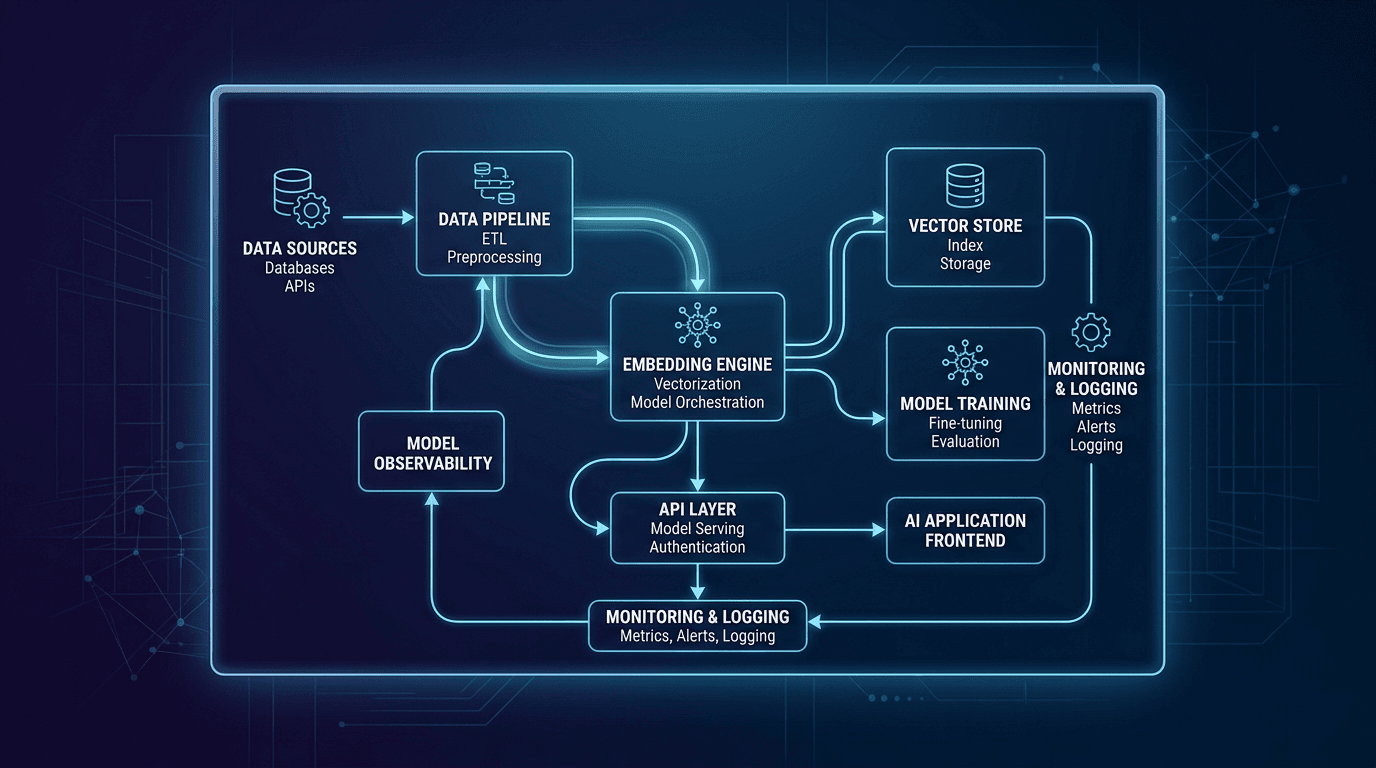
Search “what does an AI architect do” and you'll find career guides from Coursera, upGrad, and Dupple. They'll tell you the role involves “designing AI infrastructure” and “selecting cloud platforms.” They'll list skills like TensorFlow, PyTorch, and AWS. They'll mention salary ranges.
None of them are written by someone who actually does the job.
I've been an AI Lead Architect for several years. I've designed and built 13 production AI systems - from document intelligence platforms to multi-agent trading systems to legal document analyzers. Here's what the role actually looks like in practice.
The Job Isn't What Job Descriptions Say
Job descriptions focus on tools: “Experience with TensorFlow, Kubernetes, and AWS SageMaker.” The actual job is something different entirely.
An AI Lead Architect translates messy business problems into systems that work at scale and don't break when reality hits.
That single sentence contains everything. “Messy business problems” - because no client arrives with a clean spec. “Systems” - plural, because production AI is never one model; it's many components working together. “At scale” - because demos are worthless if they can't handle real load. “Don't break when reality hits” - because real data is dirty, users are unpredictable, and external APIs go down.
Here's what that looks like week by week when a company hires me.
Week 1: Discovery and Audit
I don't write code in the first week. I don't pick tools. I don't build demos.
I ask questions.
- What does your data actually look like? Not what you think it looks like - what it actually looks like. Where does it live? How clean is it? How much of it is structured vs unstructured? What are the edge cases?
- What systems exist today? CRM, ERP, document storage, databases, APIs. How do they talk to each other? Where does information get lost?
- What breaks? Every business has pain points they've learned to work around. Those workarounds reveal the real problems.
- Who are the stakeholders? The person writing the cheque, the person using the system, and the person maintaining it after I leave. Often three different people with three different priorities.
- What has been tried before? If there's a failed AI project in the history, I need to understand why it failed. Usually it's one of the five architecture mistakes I see repeatedly.
When there's an existing codebase, I also run automated analysis. I built SystemAudit.dev specifically for this - it scans any GitHub repo and maps out architecture quality, security vulnerabilities, test coverage gaps, and gives a plain-English fix plan in under 3 minutes. It's the first thing I run when inheriting an existing AI project.
By the end of week one, I know more about the company's data and systems than most people who work there. That sounds arrogant - it's not. It's because I'm looking at the data with fresh eyes and specific questions that only matter when you're designing an AI system.
Weeks 2-3: Architecture Decisions
This is where the role diverges completely from an AI developer or engineer. The decisions made in these two weeks determine 80% of the project's outcome.
The key decisions:
- RAG vs agents vs automation: Which AI pattern fits this problem? Sometimes it's one. Sometimes it's a combination. Getting this wrong means months of wasted effort building the wrong thing. (Multi-agent guide | RAG architecture guide)
- Component design: What are the distinct pieces of the system? How do they communicate? What happens when one fails? For SureCiteAI, this was 12 components. For simpler systems, it might be 4-5.
- Data architecture: How does data flow through the system? Where are the bottlenecks? What needs to be cached? What needs to be real-time vs batch?
- Build vs buy for each component: Custom embedding pipeline or OpenAI's API? Custom vector store or hosted Pinecone? Custom orchestration or LangGraph? Each decision has cost, control, and maintenance trade-offs.
- Integration design: How does this connect to the company's existing systems? This is where 40-60% of the actual work lives.
- Scaling strategy: The system needs to handle 10x expected load from day one. Not because you'll have 10x users - but because you need headroom for spikes, batch processing, and growth.
The output of these two weeks is a document - not code. An architecture document with component diagrams, data flow diagrams, integration specifications, and a clear rationale for every major decision. This document becomes the project's source of truth.
I've had projects where this document saved the company six figures. One client was about to build a custom ML pipeline for a problem that was better solved with a simple RAG system and an off-the-shelf embedding model. The architecture review caught it before they spent three months building the wrong thing.
Weeks 4-6: Build and Validate
Now I write code. But an architect builds differently than a developer.
A developer writes code that works. An architect writes code that fails gracefully.
- Error handling: Every external call has retry logic. Every database write has validation. Every AI output has a confidence check.
- Monitoring: From day one, the system logs what matters - latency, accuracy, error rates, usage patterns. Not verbose debug logging - targeted metrics that tell you if the system is healthy.
- Graceful degradation: If the LLM provider goes down, the system doesn't crash. It queues requests, serves cached responses, or falls back to a simpler model.
- Documentation: Not comments in code - system documentation that explains why decisions were made, so the team maintaining the system after I leave can make informed changes.
The goal of weeks 4-6 isn't a demo. It's a production pilot - real data, real users, real integrations - handling real workload at the scale the business needs.
AI Architect vs AI Developer vs AI Engineer
These roles are different. Companies that don't understand the difference hire the wrong one and wonder why the project fails.
| Dimension | AI Developer | AI Engineer | AI Lead Architect |
|---|---|---|---|
| Primary focus | Writing code, building features | Building systems, deploying models | Designing the system of systems |
| Key question | “How do I build this?” | “How do I deploy this reliably?” | “Should we build this at all, and how?” |
| Scope of decisions | Within a component | Across the pipeline | Across the entire system + business |
| Stakeholder communication | With other developers | With DevOps and developers | With C-suite, board, and technical team |
| What failure looks like | Buggy feature | Unreliable deployment | Wrong system for the problem |
The risk is lopsided. Three developers at £80K/year over six months is £120K spent. If the architecture is wrong, the project fails regardless of how good the code is. Six weeks of one senior architect is the smaller line item - and the architecture decisions they make determine whether the £120K in development time delivers value or gets thrown away.
When You Need an Architect
Not every AI project needs an architect. If you're building a simple chatbot that answers questions from a knowledge base, a capable developer with RAG experience can handle it.
You need an architect when:
- Your project touches multiple systems - CRM, database, document storage, external APIs. Integration complexity is an architecture problem.
- You need more than one AI pattern - RAG + agents, or retrieval + structured extraction. Combining patterns requires system design, not just coding skill.
- Scale matters - more than a handful of users, real-time requirements, or large data volumes.
- It has to integrate with legacy infrastructure - enterprise systems that weren't designed for AI require careful integration architecture.
- A previous attempt failed - the 7 signs that your project needs an architect, not another developer.
- Stakeholders need to understand what's being built - if the board is funding the project, someone needs to explain it in business terms.
The Fractional AI Architect Model
Most companies don't need a full-time AI architect. They need one for 6-12 weeks to make the critical design decisions, build the first pilot, and set up the architecture that the development team will execute against.
This is the fractional AI CTO model. You get senior architecture expertise without committing to a £150-250K annual salary. The architect designs the system, builds the pilot, documents the architecture, and hands over to your team.
For most companies at the “we need AI but don't know how to start” stage, this is the highest-ROI hire they can make. Not another developer. Not a consultant who delivers a PowerPoint. An architect who designs the system and builds the first working version.
Already have an AI project underway? If you're a decision-maker who wants to know what's really going on under the hood - without waiting for a technical review - SystemAudit.dev gives you a plain-English report on any codebase in under 3 minutes. Architecture quality, security risks, test coverage. No GitHub experience needed - just paste the repo URL and read the findings. It's what I use in Week 1 of every engagement.
Need an AI architect for your project? Describe what you're building and I'll tell you honestly what it needs. You can also review my consulting services to see the engagement models I offer.
Read Next
Ready to discuss your AI project?
Book a free 30-minute discovery call to explore how AI can transform your business. Or if you already have a codebase, get an instant architecture report at SystemAudit.dev No technical knowledge needed, results in 3 minutes.
About the Author
Nic Chin is an AI Architect and Fractional CTO who helps companies design and deploy production AI systems including RAG pipelines, multi-agent systems, and AI automation platforms. He has delivered enterprise AI solutions across the UK, US, and Europe, and provides AI consulting in Malaysia and Singapore.